PURE EXPRESSIONS

Honduras

La Mosquitia

(The Patuca River)

70% Dark Chocolate

This is chocolate for chocolate lovers. The first impression is unmistakably deep, fudgy cocoa, followed by the comforting richness of butter cookie and warm roasted peanut. Low in fruit acidity and generous in classic chocolate flavor, it is immediately approachable without being simple.

The cacao is produced by Miskitu and Tawahka farming communities along the remote Patuca River in Honduras’s La Mosquitia rainforest. Centralized fermentation and carefully controlled post-harvest processing transform this community-grown cacao into one of the most satisfyingly chocolate-forward expressions in the Pure Expressions collection.

Naturally Occurring Tasting Notes

Cocoa • Butter Cookie • Roasted Peanut

$7.50

The Details Behind the Flavor

The Cacao Record

Honduras — Miskito — 2023

Country

Honduras

Region

La Mosquitia, Gracias a DiosWampusirpi, Patuca River

Elevation

50 m · Patuca River rainforest

Cacao Identity

Natural HybridTrinitario

Harvest

2023

Fermentation

Centralized Box Fermentation

Fresh cacao from Miskitu and Tawahka farming communities was brought together for centralized box fermentation. The processing team monitored fermentation temperatures and performed cut tests to evaluate internal bean development and batch progress.

Drying

Roof-Covered Raised Beds

Following fermentation, the cacao was dried on raised beds protected by a roof. The elevated beds support airflow around the cacao, while overhead protection allows the drying team to manage frequent rainfall and humid conditions in La Mosquitia.

Certifications

Intercropping, organic production practices, and zero use of agrochemicals

Producer

Cacao Miskito producer networkSourced with Uncommon Cacao

Roast

Balanced

Genetics / Pedigree

Trinitario Heritage

Retained sourcing records identify this cacao as Trinitario, a naturally occurring hybrid population historically associated with Criollo and Amelonado ancestry.

Producer Profile

Cacao Miskito works with remote cacao-growing communities around Wampusirpi and the Patuca River in La Mosquitia. The network includes Miskitu and Tawahka producers cultivating cacao within diverse farms closely connected to the surrounding rainforest.

Fresh cacao from participating farms is brought together for centralized fermentation and drying. Temperature monitoring, fermentation cut tests, roof-covered raised beds, and coordinated quality standards help transform many small harvests into consistent specialty lots.

In 2022, the network purchased cacao from 80 producers, 55 of whom were women. Florentino Portales has played a central role in producer training, post-harvest development, and the relationship between Cacao Miskito and Uncommon Cacao.

Why We Chose This Source

This cacao gives us an opportunity to support a market built within one of Central America’s most important remaining rainforest landscapes. Agriculture and conservation are too often treated as opposing forces, but the farms of La Mosquitia show how cacao can grow among food crops, fruit trees, and forest shade.

We chose Cacao Miskito because its work connects quality, community opportunity, and forest stewardship. Centralized processing gives remote producers access to tools and markets that would be difficult for each community to reach independently, while transparent sourcing makes more of that value visible.

The flavor makes the connection tangible: deep fudge, butter cookie, and roasted peanut—a generous chocolate shaped by careful processing and the living forest surrounding it.

Honduras — Miskito — 2023

Flavor of Place

Chocolate from a Rainforest Stronghold

Along the Patuca River in northeastern Honduras, the vast La Mosquitia forest stretches across one of Central America’s last major rainforest strongholds. Cacao grows near Wampusirpi within a humid, river-shaped landscape of dense jungle, small cultivated plots, and extraordinary biological diversity.

This environment produces a cacao with very little sharp fruit acidity. Its character instead centers on deep fudge and classic cocoa, followed by butter-cookie sweetness and roasted peanut. The result is generous and immediately approachable—a chocolate-forward expression shaped by the warmth and richness of the rainforest.

Chocolate from a Rainforest Stronghold
The Patuca River passing through the forests of La Mosquitia in northeastern Honduras.

People & Place

Cacao Within a Living Forest

La Mosquitia is home to Indigenous Miskitu and Tawahka communities whose lives have long been connected to the surrounding forest and the Patuca River. Fishing and small-scale cultivation of crops such as yuca and rice historically formed the foundation of local livelihoods.

Cacao trees reached the region through exchange with other Indigenous communities and, over time, some became established within the forest. For many years they were harvested only occasionally and were not a significant source of household income.

More recently, cacao has become part of a broader effort to build opportunity without separating agriculture from the forest that sustains it. Farms commonly combine cacao with plantain, avocado, guava, citrus, rambutan, beans, corn, and shade trees—a productive landscape that remains biologically diverse.

Cacao Within a Living Forest
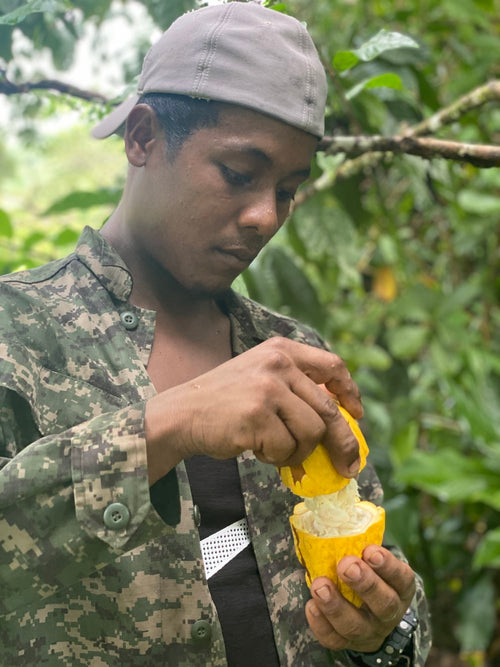
Argentina Cruz López, a cacao producer in the Miskito network, holding a freshly opened pod.

People & Provenance

Shared Processing, Measurable Progress

Cacao Miskito brings cacao from remote farming communities together for centralized fermentation and drying. Temperature monitoring, cut tests, roof-covered raised beds, and coordinated quality standards allow many small harvests to become consistent specialty lots.

Florentino Portales has played a central role in developing the network’s post-harvest approach and training producers in farm productivity, ecological practices, fermentation, and quality. This careful processing helps reveal the cacao’s unusually deep, chocolate-forward character.

In 2022, Cacao Miskito purchased from 80 producers, including 55 women. Community initiatives also provided agricultural inputs and household food-production support, while training encouraged intercropping, shade-grown cacao, and production without agrochemicals. Together, these efforts connect better cacao with stronger livelihoods and continued stewardship of the forest.

Shared Processing, Measurable Progress
Florentino Portales leading field training with younger cacao producers.

Thoughtfully selected

Simple & Clean Ingredients

Cocoa Beans*, Cane Sugar*, Cocoa Butter*

✦ Organic ingredients May contain traces of tree nuts, peanuts, wheat, or soy.

Continue the journey

Explore More Pure Expressions

Distinct cacao origins, expressed with clarity and care.

Bolivia

Pure Expressions

Bolivia

Alto Beni

70% Dark Chocolate

Naturally occurring tasting notes

Cherimoya Melon • Cinnamon • Oak

Harvest
2023
Cacao
Wild Criollo & Trinitario
$7.50
View Product
Dominican Republic

Pure Expressions

Dominican Republic

Cibao, Duarte Province

70% Dark Chocolate

Naturally occurring tasting notes

Tangy Chocolate • Dark Cherry • Molasses • Plum • Warming Spice

Harvest
2024
Cacao
Trinitario, Forastero & Criollo blend
$7.50
View Product
Mexico

Pure Expressions

Mexico

Chontalpa

70% Dark Chocolate

Naturally occurring tasting notes

Deep Cocoa • Date • Warm Caramel

Harvest
2023
Cacao
Trinitario hybrids, local Criollo & INIFAP selections
$7.50
View Product
Côte d'Ivoire

Pure Expressions

Côte d'Ivoire

The Ivory Coast

70% Dark Chocolate

Naturally occurring tasting notes

Fudgy Ganache • Toasted Nut

Harvest
2020
Cacao
Forastero
$7.50
View Product
Shop Pure Expressions →